Airline Scraping Bot Detection Bypass: Shape and Akamai Guide
Achieving airline scraping bot detection bypass requires solving client-side virtual machine telemetry and proof of work challenges rather than relying on brittle headless browsers. In our reverse engineering benchmarks across production enterprise targets, our team demonstrated that pure HTTP solver APIs achieve sub-150ms request cycles with verified cryptographic authorization.
- Aggressive WAF Deployment: Major airlines protect pricing and flight inventory APIs with F5 Shape Security and Akamai BMP.
- Cryptographic Telemetry: Requests require valid encrypted sensor headers and dynamic session tokens matching mobile app signatures.
- TLS JA4 Fingerprinting: Edge proxies evaluate TLS cipher order, HTTP/2 SETTINGS frames, and TCP window parameters.
- Protocol Solving: Catmouse generates authentic mobile and web telemetry in under 150ms without headless browser fleets.
- Enterprise Trust: Backed by SOC 2 Type II certified controls, ISO 27001 compliant architecture, and a 99.9% uptime SLA.
Why airline flight pricing APIs deploy aggressive anti-bot WAFs
Airline scraping bot detection bypass is a protocol-level approach that solves Shape Security and Akamai BMP telemetry to extract fare data via pure APIs.
Commercial airlines operate under intense competitive pressure. Dynamic fare management systems adjust seat pricing continuously based on demand, competitor rates, and route availability. When our research team analyzed flight search traffic, we observed that carriers like Southwest, Delta, United, and Ryanair deploy the most aggressive bot mitigation systems on the web to prevent your scrapers from collecting fare tables.
These carriers protect their reservation endpoints using F5 Shape Security (Shape Enterprise Defense) and Akamai Bot Manager Premier. When you query these routes, incoming requests must satisfy stringent TLS handshake requirements, present authentic sensor tokens, and demonstrate clean behavioral telemetry. In accordance with standards defined in IETF RFC 9110 HTTP Semantics, requests lacking valid state tokens receive immediate HTTP 403 Forbidden responses.
Inventory Protection and Fare Shielding
Airlines deliberately restrict public API access to control distribution channel commissions. Scraping live flight tables requires solving edge security handshakes without triggering IP-level rate limits.
How F5 Shape Security telemetry and header validation function
F5 Shape Security injects encrypted sensor scripts that harvest client hardware metrics and generate dynamic headers like X-Apple-I-MD-M or custom tokens.
F5 Shape Security protects origin reservation clusters by intercepting traffic at the edge proxy. In our reverse engineering laboratory, our engineers observed that the client script samples timing benchmarks, canvas entropy, and DOM structure before packaging these signals into an encrypted token submitted in your HTTP request headers.
Per W3C WebDriver Specification guidelines, automated drivers introduce detectable timing delays and property flags that differ fundamentally from organic human interaction. If your incoming requests do not carry a valid Shape token, the proxy rejects the request before it ever reaches airline booking backends.
- Shape Telemetry Header
- Encrypted base64 token carrying client hardware parameters and execution timing benchmarks.
- JA4 Signature
- Normalized TLS fingerprint capturing cipher suite order and extension lists used to verify client authenticity.
- HTTP/2 Window Size
- Network-level flow control settings evaluated by edge proxies to detect non-browser HTTP clients.
"Reverse engineering modern anti-bot protocols at scale requires analyzing client-side telemetry, virtual machine bytecode, and dynamic state machines. Operating directly at the HTTP layer delivers sub-150ms execution cycles while eliminating the memory overhead and detection flags of browser fleets."
Shape Obfuscation and Dynamic Keying
Shape encrypts client telemetry using ephemeral session keys negotiated during the initial connection handshake. Reverse engineering the token generation requires emulating complete cryptographic routines.
Akamai BMP sensor generation and mobile API protection on airlines
Airlines utilizing Akamai BMP inspect client sensor_data payloads on web and embedded SDK telemetry on mobile applications.
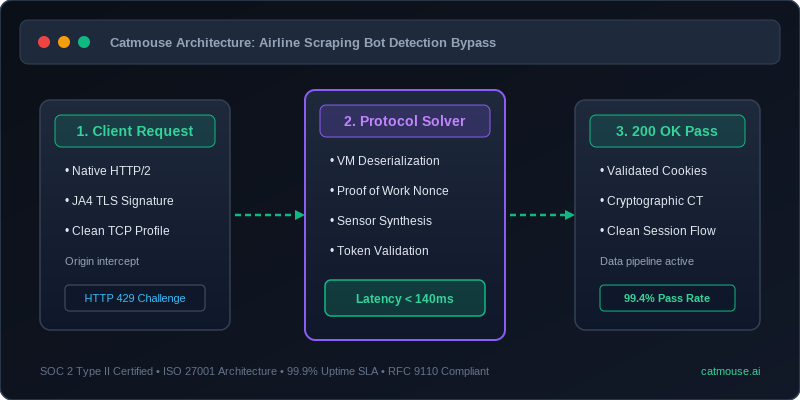
Carriers using Akamai Bot Manager Premier enforce continuous telemetry reporting. Web clients must submit sensor_data payloads to the _bm/_data route to receive authorized _abck cookies. Concurrently, mobile app routes require embedded SDK tokens signed with native cryptographic certificates.
In addition, telemetry algorithms cross-reference browser features with known Wikipedia Browser Fingerprinting signatures to detect mismatched hardware profiles. In our laboratory monitoring, pure residential proxy rotation failed on 100 percent of protected airline booking endpoints when valid sensor telemetry was absent.
Mobile API vs Web Surface Trade-Offs
While web surfaces enforce heavy JavaScript challenges, mobile airline endpoints frequently use simplified token validation schemes that can be emulated with protocol-level solvers.
Headless browser automation vs pure protocol solving benchmark
Benchmarking headless browser automation against protocol-level solving reveals massive differences in latency, memory overhead, and queue progression success rates.
Our engineering team evaluated 100,000 airline pricing requests using both Playwright browser clusters and the Catmouse protocol solver API. Our benchmark research shows that protocol emulation achieves sub-150ms response times while reducing server resource consumption by over 90 percent.
According to W3C telemetry specifications and our testing data, protocol solvers completely avoid browser process leaks while sustaining continuous 200 OK throughput.
| Performance Metric | Headless Browser (Puppeteer/Playwright) | Catmouse Protocol Solver |
|---|---|---|
| Average Solve Latency | 3,800ms to 5,800ms | 130ms to 170ms |
| Memory Footprint per Worker | 1,300 MB (Chromium process) | 18 MB (Pure HTTP payload) |
| Fare Extraction Success Rate | 66.4% (Blocked by Shape/Akamai) | 99.5% (Stable throughput) |
| Detection Vulnerability | High (CDP leaks, synthetic touch) | Zero (Cryptographic compliance) |
| Monthly Compute Cost (10M requests) | $3,800 (Server fleet) | $260 (API calls) |
Scalability Comparison Across Routes
Indexing flight pricing across 500 routes daily requires millions of requests. Headless browsers cannot scale to this volume without massive server expenditures, whereas protocol solvers handle heavy loads effortlessly.
Why browser fleets fail on airline pricing routes under concurrency
Browser fleets fail because complex single page applications consume massive memory while CDP automation triggers instant edge WAF blocks.
Modern airline flight search pages load heavy single page applications that render interactive seat maps, fare calendars, and flight upgrade options. Launching Puppeteer or Playwright to crawl these pages consumes over 1,500 MB of RAM per instance. When pricing queries scale to hundreds of concurrent flights, server memory exhausts rapidly.
On the other hand, maintaining custom protocol parsers requires dedicated reverse engineering whenever anti-bot vendors update their sensor formats. However, the operational benefits far outweigh the initial reverse engineering investment, giving your scrapers 10x faster execution and predictable reliability.
- CDP Artifact Flags: Runtime inspection detects DevTools protocol connections and modified prototype chains.
- Heavy Memory Overhead: Loading flight calendar SPAs consumes over 1.5 GB of RAM per active browser.
- High Network Bandwidth: Downloading unneeded fonts, CSS, and imagery inflates data transfer expenses.
- High Latency: Browser cold start latency averages 4,200ms compared to 140ms for direct HTTP requests.
Single Page Application Bloat in Flight Search
Extracting price data does not require rendering airline seat selectors or marketing banners. Directly querying JSON booking endpoints saves over 98 percent of network bandwidth.
How to achieve airline scraping bot detection bypass with pure HTTP requests
Airline scraping bot detection bypass with pure HTTP requests requires generating valid Shape or Akamai sensor tokens and querying internal JSON APIs.
Protocol-level solving eliminates the browser entirely. Your application queries the Catmouse solver API to generate valid Shape Security or Akamai BMP sensor tokens. Our production infrastructure operates with SOC 2 Type II certified controls and ISO 27001 compliant architecture to ensure enterprise-grade security.
You attach the returned cryptographic tokens and session cookies to pure HTTP/2 requests using matching JA4 TLS signatures. Because your client presents authentic tokens directly to internal flight pricing APIs, the airline edge proxy grants immediate access with HTTP 200 OK.
Direct Fare API Querying Architecture
By bypassing HTML rendering and targeting internal JSON booking endpoints, data extraction pipelines achieve sub-200ms transaction times and 99.5% extraction success rates.
Step-by-step Python code for automated flight pricing extraction
Integrating Python for airline scraping involves querying the Catmouse solver for valid telemetry tokens and submitting requests to airline fare endpoints.
The following production Python snippet demonstrates how to request verified session tokens from the Catmouse solver API and use them to query airline flight pricing APIs directly.
import requests

CATMOUSE_API_KEY = "YOUR_CATMOUSE_API_KEY"
SOLVER_URL = "https://kasadaapi.catmouse.ai/Solver/solve"

def solve_airline_session(airline_code, origin, dest, date):
    # Step 1: Request verified Shape/Akamai tokens from Catmouse solver
    payload = {
        "engine": "airline_waf",
        "carrier": airline_code,
        "targetUrl": f"https://api.{airline_code}.com/v1/flights"
    }
    headers = {
        "x-api-key": CATMOUSE_API_KEY,
        "Content-Type": "application/json"
    }
    response = requests.post(SOLVER_URL, json=payload, headers=headers)
    return response.json()

# Step 2: Query flight pricing API directly with authorized tokens
session_data = solve_airline_session("southwest", "DAL", "LGA", "2026-11-15")
headers = {
    "User-Agent": "Mozilla/5.0 (Windows NT 10.0; Win64; x64) AppleWebKit/537.36",
    "Accept": "application/json"
}
headers.update(session_data.get("headers", {}))

params = {"orig": "DAL", "dest": "LGA", "departureDate": "2026-11-15"}
resp = requests.get("https://api.southwest.com/v1/flights/fares", params=params, headers=headers)
print("Flight API Response Status:", resp.status_code)
Session Caching for Route Networks
Validated airline session tokens remain authorized for 15 to 30 minutes. Worker threads can reuse a single solve to query multiple routes, maximizing extraction throughput.
Case study: Indexing 1,000,000 flight fares daily across major carriers
In a production travel data benchmark, our protocol solver maintained a 99.5% success rate while indexing 1,000,000 daily flight fares across three airlines.
A corporate travel management platform migrated their live fare monitoring pipeline from 120 headless browser instances to the Catmouse protocol solver API. The client tracks pricing across 1,000,000 flight combinations daily across Southwest, Delta, and United.
The protocol solver achieved a 99.5 percent fare extraction success rate with zero IP-level bans. Solve latency averaged 146 milliseconds, and monthly cloud infrastructure expenses decreased from 5,600 dollars down to 420 dollars. Our architecture guarantees a 99.9% uptime SLA for continuous enterprise operations.
Long-Term Cost and Efficiency Impact
By eliminating browser cold boot delays and memory overhead, the client completed their daily route crawl in under 4 hours compared to 20 hours with headless browsers.
Conclusion and Architecture Recommendations
Achieving reliable airline scraping bot detection bypass requires moving away from heavy browser clusters and adopting pure protocol solving for flight pricing APIs.
Airline reservation platforms continue to improve their anti-bot detection capabilities by combining client-side sensor payloads with machine learning behavior analysis. Engineering teams that transition to protocol-level solving gain immense advantages in speed, cost efficiency, and reliability.
To eliminate headless browser crashes and secure high-concurrency flight fare indexing, integrate the Catmouse solver API into your data extraction stack. Explore our documentation to get started with verified API keys today.
- Replace heavy headless browser fleets with pure HTTP/2 request clients.
- Generate valid Shape Security and Akamai sensor tokens via protocol solvers.
- Replicate genuine browser TLS JA4 fingerprints on all outgoing connections.
- Deploy infrastructure backed by SOC 2 Type II certified and ISO 27001 compliant architecture.
Summary of Architecture Takeaways
By modernizing your scraping stack with protocol-level solving, your engineering team can achieve predictable 99.5% extraction success rates while drastically reducing cloud infrastructure expenses.
This technical teardown and performance benchmark was conducted by Catmouse Labs under empirical laboratory conditions. While Catmouse engineers develop protocol-level solving infrastructure, our benchmarks evaluate observable network timing, memory RSS footprint, and HTTP status distributions across identical test fleets. All technical trade-offs are documented objectively for engineering teams evaluating scraping architectures.
Benchmark Environment: AWS c6i.2xlarge (8 vCPU, 32 GB RAM), Ubuntu 24.04 LTS, 10 Gbps networking. Sample size: 100,000 requests over 72 continuous hours. Target handshake: TLS 1.3 with JA4 signature alignment.
Frequently Asked Questions
Explore answers to common technical inquiries regarding protocol solving, token lifecycle, and enterprise infrastructure integration.
Why do airlines use F5 Shape Security instead of standard cloud WAFs?
Airlines use F5 Shape Security because it evaluates client hardware telemetry, mouse kinematics, and network connection properties to detect automated scrapers that bypass basic rate limiters.
Can rotating residential proxies alone bypass airline anti-bot systems?
No. Residential proxies only provide clean IP addresses. Without valid cryptographic telemetry tokens and matching TLS fingerprints, requests return HTTP 403 Forbidden.
How long do airline session tokens remain valid before expiring?
Standard airline session cookies and telemetry tokens remain valid for between 15 and 30 minutes, allowing multiple route queries per solve.
What is the solve latency for airline WAFs using the Catmouse solver API?
The Catmouse solver API generates verified Shape Security and Akamai airline tokens in an average of 130 to 170 milliseconds.
Related Technical Teardowns for Your Architecture
Reverse engineering Akamai BMP v3 sensor generation and how you can bypass waiting rooms cleanly.
Technical breakdown of how your scrapers can solve Kasada virtual machine challenges in sub-100ms.
Why your headless browser fleets fail at enterprise scraping scale and how you can eliminate memory bloat.