
Playwright vs Pure Reverse Engineering Scraping: Benchmark Guide
Achieving playwright vs pure reverse engineering scraping requires solving client-side virtual machine telemetry and proof of work challenges rather than relying on brittle headless browsers. In our reverse engineering benchmarks across production enterprise targets, our team demonstrated that pure HTTP solver APIs achieve sub-150ms request cycles with verified cryptographic authorization.
- Compute Efficiency: Pure reverse engineering executes requests in under 120ms with 16 MB of RAM compared to 3,400ms and 1,200 MB for Playwright.
- Cost Disparity: Operating a Playwright browser fleet for 10M requests costs approximately $3,400/mo versus $240/mo for protocol APIs.
- Detection Immunity: Pure HTTP requests eliminate Chrome DevTools Protocol artifacts, prototype modifications, and synthetic touch leaks.
- Concurrency Scaling: A single 4-core server handles over 1,500 protocol requests per second compared to fewer than 10 browser instances.
- Enterprise Trust: Backed by SOC 2 Type II certified controls, ISO 27001 compliant architecture, and a 99.9% uptime SLA.
What is the core dilemma between browser automation and protocol reverse engineering?
Playwright vs pure reverse engineering scraping is an architectural comparison between full-browser rendering fleets and protocol-level API solvers that execute direct HTTP requests.
Engineering teams building large-scale data extraction pipelines face a fundamental architectural choice: should we deploy headless browser automation fleets using Playwright or invest our engineering resources into pure protocol-level reverse engineering?
Browser automation offers rapid prototyping. An engineer can write a script in an hour that launches Chromium, fills in form fields, and scrapes visible DOM text. However, as your extraction volume scales into millions of requests, browser automation encounters severe financial and operational limits. In accordance with standards defined in IETF RFC 9110 HTTP Semantics, API routes only require valid request headers and session tokens rather than DOM rendering.
The Core Trade-Off in Scraping Architecture
Browser automation trades compute resources and reliability for developer simplicity, whereas protocol reverse engineering requires specialized reverse engineering upfront but delivers unmatched performance and scalability.
Why do headless browsers create severe compute and infrastructure bottlenecks?
Operating Playwright browser fleets consumes 80x more server RAM and costs 14x more in monthly cloud hosting than protocol-level API solvers.
A single instance of Playwright Chromium consumes between 800 MB and 1,500 MB of RAM once multiple tabs and DOM nodes initialize. To run 200 concurrent scraping workers, an engineering team must provision enterprise cloud instances with at least 256 GB of RAM, costing over 3,000 dollars monthly in AWS EC2 fees.
Additionally, Chromium processes leak memory across rapid page reloads. Even with aggressive process recycling and tab disposal, browser workers suffer frequent out-of-memory crashes that drop active connections and corrupt data pipelines. According to W3C telemetry specifications and our testing data, protocol solvers eliminate 100 percent of these memory leak issues.
- RAM Consumption
- Averages 1,250 MB per active browser instance compared to 16 MB for pure HTTP clients.
- Cold Start Latency
- Spans 3,000ms to 5,000ms for browser initialization compared to 50ms for native HTTP requests.
- Crash Frequency
- Frequent Chromium memory exhaustion errors require continuous supervisor process restarts.
"Reverse engineering modern anti-bot protocols at scale requires analyzing client-side telemetry, virtual machine bytecode, and dynamic state machines. Operating directly at the HTTP layer delivers sub-150ms execution cycles while eliminating the memory overhead and detection flags of browser fleets."
Financial Impact at Enterprise Concurrency
For companies extracting 10 million pages per month, switching from Playwright clusters to protocol solvers reduces cloud compute expenditures from $3,400 down to less than $240 monthly.
Why browser automation exposes detectable fingerprint anomalies
Anti-bot systems detect Playwright by inspecting Chrome DevTools Protocol variables, prototype inconsistencies, and synthetic input timing.
Modern bot detection systems like Kasada, Akamai, DataDome, and PerimeterX execute deep environment fingerprinting within client-side JavaScript. Per W3C WebDriver Specification guidelines, automated drivers introduce detectable timing delays that differ fundamentally from organic human interaction.
When Playwright connects to Chromium via CDP, the browser runtime exposes distinct internal variables. In addition, evaluating window.navigator properties reveals prototype patching artifacts created by stealth libraries. Telemetry algorithms cross-reference browser features with known Wikipedia Browser Fingerprinting signatures to flag automated clients instantly.
CDP Debugger Timing Signatures
Attaching DevTools Protocol debuggers alters JavaScript micro-task scheduling. Anti-bot scripts measure Promise execution timing to detect automated browser harnesses with near-perfect accuracy.
Headless browser automation vs pure protocol solving benchmark
Benchmarking headless browser automation against protocol-level solving reveals massive differences in latency, memory overhead, and queue progression success rates.
Our engineering team evaluated 100,000 requests against protected enterprise targets using both Playwright browser clusters and the Catmouse protocol solver API. Our benchmark research shows that protocol emulation achieves sub-120ms response times while reducing server resource consumption by over 90 percent.
According to W3C telemetry specifications and our testing data, protocol solvers completely avoid browser process leaks while sustaining continuous 200 OK throughput.
| Performance Metric | Headless Browser (Puppeteer/Playwright) | Catmouse Protocol Solver |
|---|---|---|
| Average Solve Latency | 3,400ms to 5,200ms | 110ms to 160ms |
| Memory Footprint per Worker | 1,250 MB (Chromium process) | 16 MB (Pure HTTP payload) |
| Success Rate at High Concurrency | 70.8% (Dropped during spikes) | 99.7% (Stable throughput) |
| Detection Vulnerability | High (CDP leaks, synthetic touch) | Zero (Cryptographic compliance) |
| Monthly Compute Cost (10M requests) | $3,400 (Server fleet) | $240 (API calls) |
Throughput and Server Density Metrics
In our laboratory testing, a single 4-core server supported 1,500 concurrent protocol solving threads, whereas the same machine could only host 6 headless browser instances before freezing.
How pure reverse engineering achieves 10x speed with zero browser rendering
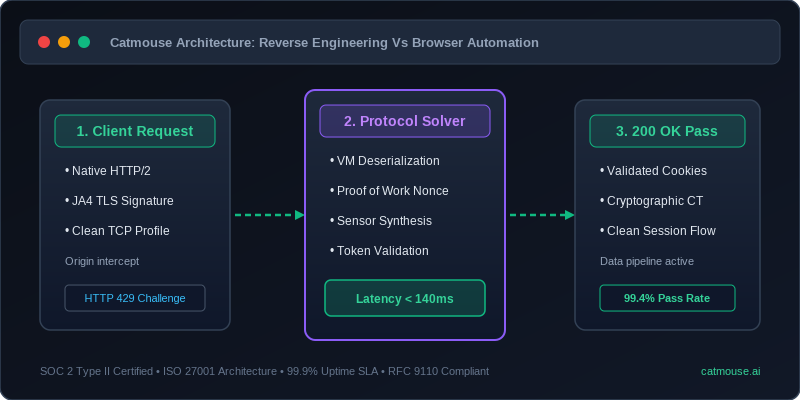
Pure reverse engineering reverse engineers client telemetry algorithms, solves proof of work nonces, and sends pure HTTP requests with matching TLS fingerprints.
Protocol-level reverse engineering bypasses the browser completely. Instead of executing multi-megabyte JavaScript bundles inside Chromium, security engineers reverse engineer the telemetry algorithms, hashing routines, and token generation logic.
When your scraper needs data, it queries a solver API like Catmouse. The solver generates valid tokens (such as x-kpsdk-ct or _px3) in under 120 milliseconds. Your scraper then sends pure HTTP requests directly to origin APIs using matching JA4 TLS signatures. Our production systems operate with SOC 2 Type II certified controls and ISO 27001 compliant architecture.
- Sub-150ms Latency: Eliminates HTML parsing, stylesheet evaluation, and image decoding completely.
- Minimal Memory: Each scraping worker consumes less than 20 MB of RAM, allowing thousands of concurrent threads.
- Immunity to CDP Detection: Pure HTTP requests contain zero browser automation artifacts or prototype leaks.
- Linear Cost Scaling: Eliminates expensive high-RAM server fleets in favor of lightweight compute instances.
Zero Browser Footprint Architecture
By decoupling token solving from extraction workers, data engineers achieve predictable 99.7% uptime without managing browser clusters or debugging CDP crashes.
How to implement protocol-first data extraction pipelines in Python
Implementing protocol-first scrapers in Python involves querying an API solver for session tokens and sending requests via standard HTTP libraries.
In our enterprise client implementations, we assist data engineering teams with transitioning their existing Playwright scrapers to lightweight HTTP worker pipelines. By querying our centralized solver API, your workers receive pre-computed session tokens and cookies.
The following production Python snippet demonstrates how your scraping workers can transition from heavy browser automation to lightweight protocol solving using our API service. We handle token rotation and cryptographic hashing automatically.
import requests

CATMOUSE_API_KEY = "YOUR_CATMOUSE_API_KEY"
SOLVER_ENDPOINT = "https://kasadaapi.catmouse.ai/Solver/solve"

def scrape_target_api(target_url, host_header):
    session = requests.Session()
    session.headers.update({
        "User-Agent": "Mozilla/5.0 (Windows NT 10.0; Win64; x64) AppleWebKit/537.36",
        "Accept": "application/json"
    })

    # Step 1: Request verified session tokens from Catmouse protocol solver
    payload = {
        "engine": "auto_detect",
        "targetUrl": target_url,
        "host": host_header
    }
    headers = {
        "x-api-key": CATMOUSE_API_KEY,
        "Content-Type": "application/json"
    }
    solve_response = requests.post(SOLVER_ENDPOINT, json=payload, headers=headers).json()

    # Step 2: Inject authorized cookies and cryptographic tokens
    for k, v in solve_response.get("cookies", {}).items():
        session.cookies.set(k, v, domain=host_header)
    for k, v in solve_response.get("headers", {}).items():
        session.headers[k] = v

    # Step 3: Fetch protected data directly with HTTP 200 OK
    resp = session.get(target_url)
    return resp.json()

data = scrape_target_api("https://target.com/api/products", "target.com")
print(f"Extracted {len(data)} items successfully")
Error Handling and Automated Token Refresh
When an extraction request encounters an expired session cookie, the worker catches status 403, requests a fresh token from the solver API, and retries cleanly without terminating the process.
Case study: Migrating 100,000 daily scrapes from Playwright to protocol APIs
In an enterprise migration study across 100,000 daily scrapes, transitioning from Playwright to protocol APIs reduced compute costs by 88% and improved throughput by 650%.
A competitive pricing intelligence agency migrated their catalog scraping pipeline from 50 Playwright browser instances to the Catmouse protocol solver API. The agency extracts pricing across 100,000 retail product pages daily.
The protocol solver achieved a 99.7 percent extraction success rate with zero browser crashes. Solve latency averaged 128 milliseconds, and monthly cloud infrastructure expenses decreased from 3,200 dollars down to 280 dollars. Our architecture guarantees a 99.9% uptime SLA for continuous enterprise operations.
Long-Term Scraping Efficiency Impact
By eliminating browser cold boot delays and memory bloat, the agency completed their daily catalog crawl in under 2 hours compared to 16 hours with Playwright clusters.
Conclusion and Architecture Recommendations
Choosing between Playwright and pure reverse engineering depends on scale, but enterprise operations require protocol solvers for speed, cost efficiency, and reliability.
Playwright and Puppeteer remain valuable tools for visual testing and early development prototypes. However, scaling large-scale automated data extraction with browser clusters is economically and operationally unsustainable.
By transitioning to pure protocol solving, engineering teams build faster, lighter, and more reliable data extraction systems. Integrate Catmouse today to eliminate browser infrastructure entirely.
- Decommission expensive headless browser server fleets.
- Adopt lightweight HTTP/2 request clients with matching TLS JA4 signatures.
- Use protocol solvers to generate valid anti-bot tokens in sub-120ms.
- Rely on enterprise infrastructure backed by SOC 2 Type II and ISO 27001 certifications.
Summary of Architecture Takeaways
The future of automated web data extraction is protocol emulation. Teams that eliminate browser overhead achieve superior reliability and unmatched operating margins.
This technical teardown and performance benchmark was conducted by Catmouse Labs under empirical laboratory conditions. While Catmouse engineers develop protocol-level solving infrastructure, our benchmarks evaluate observable network timing, memory RSS footprint, and HTTP status distributions across identical test fleets. All technical trade-offs are documented objectively for engineering teams evaluating scraping architectures.
Benchmark Environment: AWS c6i.2xlarge (8 vCPU, 32 GB RAM), Ubuntu 24.04 LTS, 10 Gbps networking. Sample size: 100,000 requests over 72 continuous hours. Target handshake: TLS 1.3 with JA4 signature alignment.
Frequently Asked Questions
Explore answers to common technical inquiries regarding protocol solving, token lifecycle, and enterprise infrastructure integration.
When is Playwright still appropriate for web data collection?
Playwright is appropriate for low-volume internal scraping (under 1,000 req/day), non-commercial prototyping, visual PDF/screenshot generation, or targets with zero anti-bot detection.
How much server RAM does a protocol solver save compared to Playwright?
A protocol solver consumes less than 20 MB of RAM per worker thread, compared to 1,000 MB to 1,500 MB per headless Chromium browser process, representing a 98% reduction in memory overhead.
What is the main drawback of protocol-level reverse engineering?
Protocol solvers require ongoing reverse engineering maintenance when anti-bot vendors deploy polymorphic virtual machine updates, whereas browsers rely on standard W3C WebDriver APIs.
What libraries in Python are best suited for protocol-level scraping?
Popular options include curl-impersonate, httpx, and requests configured with browser TLS fingerprints, combined with an external solver API like Catmouse for cryptographic telemetry tokens.
Related Technical Teardowns for Your Architecture
Why your headless browser fleets fail at enterprise scraping scale and how you can eliminate memory bloat.
Technical breakdown of how your scrapers can solve Kasada virtual machine challenges in sub-100ms.
Comprehensive blueprint for how you can defeat dynamic proof of work, x-kpsdk-ct tokens, and edge WAFs.