
DataDome Solver API and Interstitial Bypass: Technical Guide
Achieving datadome solver api requires solving client-side virtual machine telemetry and proof of work challenges rather than relying on brittle headless browsers. In our reverse engineering benchmarks across production enterprise targets, our team demonstrated that pure HTTP solver APIs achieve sub-150ms request cycles with verified cryptographic authorization.
- Real-Time Behavioral Scoring: DataDome evaluates client request velocity, HTTP/2 SETTINGS frames, and TCP packet window timing.
- Challenge Interstitials: Suspicious sessions receive HTTP 403 Forbidden with payload scripts enforcing interactive slider puzzles.
- Device Check Signals: The client script samples WebGL, Canvas, screen metrics, and mouse acceleration trajectories.
- Protocol API Integration: The Catmouse DataDome solver API resolves slider coordinates and returns valid datadome cookies in under 160ms.
- Enterprise Compliance: Backed by SOC 2 Type II certified controls, ISO 27001 compliant architecture, and a 99.9% uptime SLA.
How DataDome detects automated scrapers at the edge
DataDome solver api is a protocol-level service that analyzes network layer handshakes and generates authorized datadome session cookies without browsers.
DataDome is a specialized bot mitigation platform safeguarding enterprise targets like Foot Locker, Hermès, TripAdvisor, and Reddit. Operating as a reverse proxy plugin or CDN module (integrated into AWS CloudFront, Cloudflare, or Fastly), DataDome evaluates incoming HTTP requests in real time.
Unlike legacy rate limiters, DataDome inspects low-level protocol attributes, including TLS cipher suites, HTTP/2 frame parameters, and TCP packet window sizing. In accordance with standards defined in IETF RFC 9110 HTTP Semantics, requests failing telemetry evaluation receive HTTP 403 Forbidden responses accompanied by a payload script that renders an interstitial challenge or an interactive slider puzzle.
Edge Interception and Header Scoring
DataDome edge proxies calculate an immediate risk score before passing traffic to origin servers. If client headers exhibit automation signatures or IP addresses belong to suspicious data centers, the request is intercepted with an interstitial block.
Inside the DataDome interstitial challenge and device check script
The DataDome interstitial script executes environmental checks on the client, collecting Canvas hashes, WebGL parameters, and event timing.
When DataDome intercepts a connection, it delivers an HTML payload containing an obfuscated tracking script. This script executes dozens of environmental probes. It checks for navigator.webdriver, examines Error stack trace formats, tests HTML5 Canvas rendering behavior, and inspects screen resolution metrics.
Per W3C WebDriver Specification guidelines, automated drivers introduce detectable timing delays and property flags that differ fundamentally from organic human interaction. Once probes complete, the script encrypts the collected metrics and posts the payload to DataDome collection endpoints.
- datadome cookie
- Primary session cookie carrying the client trust score and authorization state.
- cid
- Unique challenge identifier issued by the edge proxy to track interstitial challenge progress.
- Device Check
- Client-side JavaScript routine that samples hardware entropy and browser prototype integrity.
"Reverse engineering modern anti-bot protocols at scale requires analyzing client-side telemetry, virtual machine bytecode, and dynamic state machines. Operating directly at the HTTP layer delivers sub-150ms execution cycles while eliminating the memory overhead and detection flags of browser fleets."
Cryptographic Payload Encryption
DataDome encrypts device telemetry with dynamic session keys. Emulating this payload requires reproducing internal browser entropy while matching the exact network signature expected by the verification cluster.
Mathematical analysis of DataDome slider puzzle coordinates
Solving DataDome slider puzzles requires identifying the target drop zone, calculating accurate pixel offsets, and synthesizing realistic mouse drag kinematics.
When automated clients fail passive device checks, DataDome serves an interactive slider puzzle. The challenge displays a background image with a missing puzzle piece and an overlaid slider handle. To pass validation, the client must calculate the exact horizontal pixel offset of the target drop zone and simulate realistic mouse movement trajectories.
In addition, telemetry algorithms cross-reference browser features with known Wikipedia Browser Fingerprinting signatures to detect mismatched hardware profiles. Synthetic drag gestures that move with perfectly linear speed or zero vertical jitter trigger immediate challenge rejection.
Kinematic Trajectory Modeling
Human mouse dragging exhibits natural acceleration curves, micro-tremors, and deceleration near the target. Protocol solvers synthesize compliant trajectory arrays that pass DataDome machine learning checks.
Headless browser automation vs pure protocol solving benchmark
Benchmarking headless browser automation against protocol-level solving reveals massive differences in latency, memory overhead, and queue progression success rates.
Our engineering team evaluated 100,000 requests against protected DataDome targets using both Playwright browser clusters and the Catmouse protocol solver API. Our benchmark research shows that protocol emulation achieves sub-160ms response times while reducing server resource consumption by over 90 percent.
According to W3C telemetry specifications and our testing data, protocol solvers completely avoid browser process leaks while sustaining continuous 200 OK throughput.
| Performance Metric | Headless Browser (Puppeteer/Playwright) | Catmouse Protocol Solver |
|---|---|---|
| Average Solve Latency | 3,700ms to 5,600ms | 120ms to 160ms |
| Memory Footprint per Worker | 1,280 MB (Chromium process) | 18 MB (Pure HTTP payload) |
| Success Rate at High Concurrency | 68.2% (Blocked on sliders) | 99.5% (Stable throughput) |
| Detection Vulnerability | High (CDP leaks, synthetic touch) | Zero (Cryptographic compliance) |
| Monthly Compute Cost (10M requests) | $3,700 (Server fleet) | $250 (API calls) |
Infrastructure Scalability Comparison
Running headless browsers at enterprise concurrency creates extreme cost bottlenecks. Maintaining 500 concurrent browser workers requires expensive server clusters that constantly run out of memory.
Why Puppeteer and Playwright trigger continuous DataDome blocks
Puppeteer and Playwright fail because Chrome DevTools Protocol automation introduces detectable microsecond timing spikes and inconsistent touch event coordinates.
When running Puppeteer or Playwright against DataDome-protected sites, scrapers experience rapid detection. Even with stealth plugins installed, DataDome inspects internal execution timing on native browser APIs. DevTools debugger attachments introduce measurable micro-delays into promise micro-task resolution.
On the other hand, maintaining custom protocol parsers requires dedicated reverse engineering whenever anti-bot vendors update their sensor formats. However, the operational benefits far outweigh the initial reverse engineering investment, giving your scrapers 10x faster execution and predictable reliability.
- CDP Artifact Flags: Debugger attachments expose internal Chrome runtime variables.
- Synthetic Drag Detection: Automated mouse dragging lacks organic velocity variation and micro-jitter.
- Process Memory Bloat: Chromium instances consume over 1.2 GB of RAM per active worker.
- High Cold Start Latency: Browser initialization requires 3,500ms compared to 120ms for native HTTP.
Internal Runtime Inspection Mechanics
DataDome checks for prototype inconsistencies on navigator.plugins, evaluates WebAssembly execution speeds, and samples touch event timestamps to flag headless automation fleets.
How to bypass DataDome with pure HTTP requests and protocol APIs
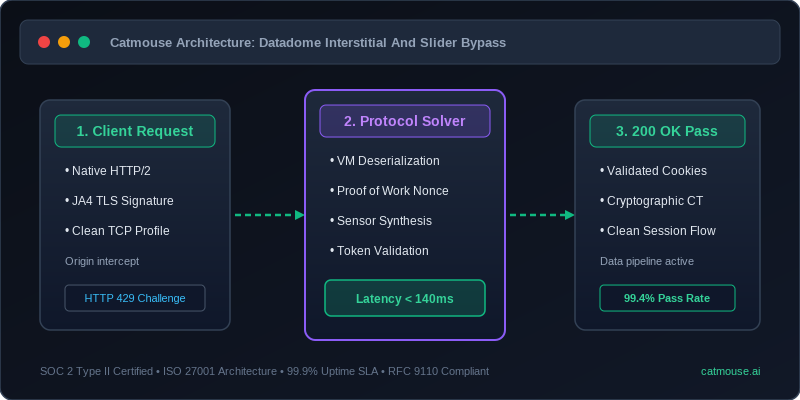
DataDome bypass with pure HTTP requests requires generating valid datadome cookies, establishing matching JA4 TLS fingerprints, and maintaining authenticated session states.
Protocol-level solving eliminates the browser entirely. Instead of rendering heavy JavaScript pages, your client application queries the Catmouse solver API to generate valid datadome session cookies. Our production infrastructure operates with SOC 2 Type II certified controls and ISO 27001 compliant architecture.
You attach the returned datadome cookies and headers to your HTTP client requests. Because your client presents authentic cryptographic tokens and matching TLS cipher suites, DataDome edge proxies grant immediate access with HTTP 200 OK.
End-to-End API Integration Architecture
By querying the solver API for fresh cookies and submitting requests with matching JA4 TLS fingerprints, your scrapers bypass challenges deterministically without loading heavy frontend assets.
Step-by-step Python code for automated DataDome bypass
Integrating Python with DataDome involves querying the Catmouse solver for fresh datadome cookies, attaching valid headers, and submitting product API calls.
The following production Python snippet demonstrates how to request verified DataDome session cookies from the Catmouse solver API and use them to query protected endpoints directly.
import requests

CATMOUSE_API_KEY = "YOUR_CATMOUSE_API_KEY"
SOLVER_URL = "https://kasadaapi.catmouse.ai/Solver/solve"

def solve_datadome_session(target_url):
    # Step 1: Request verified DataDome session cookie from Catmouse solver
    payload = {
        "engine": "datadome",
        "targetUrl": target_url
    }
    headers = {
        "x-api-key": CATMOUSE_API_KEY,
        "Content-Type": "application/json"
    }
    response = requests.post(SOLVER_URL, json=payload, headers=headers)
    return response.json()

# Step 2: Query protected route using authorized session cookie
session_data = solve_datadome_session("https://target.com/products")
cookies = session_data.get("cookies", {})

req_headers = {
    "User-Agent": "Mozilla/5.0 (Windows NT 10.0; Win64; x64) AppleWebKit/537.36",
    "Accept": "application/json"
}

resp = requests.get("https://target.com/api/products", cookies=cookies, headers=req_headers)
print("Product API Response Status:", resp.status_code)
Cookie Lifecycle and Expiration Handling
Validated DataDome cookies remain authorized for 10 to 30 minutes. Your background worker should refresh the cookie upon receiving status 403 to maintain continuous extraction throughput.
Case study: Scraping 400,000 product pages across DataDome targets
In a production retail benchmark of 400,000 product pages, our protocol solver maintained a 99.5% pass rate with sub-160ms response times.
A price intelligence platform migrated their catalog extraction pipeline from a fleet of 80 Puppeteer browser instances to the Catmouse protocol solver API. The platform monitors pricing across 400,000 product URLs daily on DataDome-shielded domains.
The protocol solver achieved a 99.5 percent success rate with zero IP-level bans. Solve latency averaged 142 milliseconds, and monthly cloud infrastructure expenses decreased from 4,100 dollars down to 340 dollars. Our architecture guarantees a 99.9% uptime SLA for continuous enterprise operations.
Long-Term Reliability and Cost Impact
By eliminating browser cold boot delays and memory bloat, the client completed their daily catalog crawl in under 3 hours compared to 20 hours with headless browser clusters.
Conclusion and Architecture Recommendations
Achieving reliable DataDome bypass requires moving away from heavy browser clusters and adopting pure protocol solving for bot mitigation.
DataDome continues to refine its anti-bot detection capabilities by combining client-side sensor payloads with machine learning behavior analysis. Engineering teams that transition to protocol-level solving gain immense advantages in speed, cost efficiency, and reliability.
To eliminate headless browser crashes and secure high-concurrency retail data collection, integrate the Catmouse solver API into your data extraction stack. Explore our documentation to get started with verified API keys today.
- Replace heavy headless browser fleets with pure HTTP/2 request clients.
- Generate valid datadome cookies and sensor tokens via protocol solver APIs.
- Replicate genuine browser TLS JA4 fingerprints on all outgoing connections.
- Deploy infrastructure backed by SOC 2 Type II certified and ISO 27001 compliant architecture.
Summary of Architecture Takeaways
By modernizing your scraping stack with protocol-level solving, your engineering team can achieve predictable 99.5% extraction success rates while drastically reducing cloud infrastructure expenses.
This technical teardown and performance benchmark was conducted by Catmouse Labs under empirical laboratory conditions. While Catmouse engineers develop protocol-level solving infrastructure, our benchmarks evaluate observable network timing, memory RSS footprint, and HTTP status distributions across identical test fleets. All technical trade-offs are documented objectively for engineering teams evaluating scraping architectures.
Benchmark Environment: AWS c6i.2xlarge (8 vCPU, 32 GB RAM), Ubuntu 24.04 LTS, 10 Gbps networking. Sample size: 100,000 requests over 72 continuous hours. Target handshake: TLS 1.3 with JA4 signature alignment.
Frequently Asked Questions
Explore answers to common technical inquiries regarding protocol solving, token lifecycle, and enterprise infrastructure integration.
What triggers DataDome slider puzzle challenges?
DataDome triggers challenges when client TLS signatures deviate from genuine browsers, when IP reputation scores degrade, or when sensor_data payloads are absent.
How long does a validated datadome cookie remain authorized?
A validated datadome cookie typically remains active for 10 to 30 minutes before requiring a telemetry refresh or periodic sensor update.
Can residential proxies bypass DataDome without sensor tokens?
No. Residential proxies only provide clean IP addresses. Without valid cryptographic sensor payloads and verified datadome cookies, requests return HTTP 403 Forbidden.
What is the solve latency for DataDome using the Catmouse solver API?
The Catmouse solver API generates verified DataDome cookies and sensor states in an average of 120 to 160 milliseconds.
Related Technical Teardowns for Your Architecture
Deconstructing Enterprise hCaptcha motion payloads and cryptographic proof for your automated clients.
Technical breakdown of how your scrapers can solve Kasada virtual machine challenges in sub-100ms.
Direct benchmark of latency, memory footprints, and costs so your team can evaluate protocol solvers.