
ThreatMetrix Profiling Bypass and Device DNA: Technical Guide
Achieving threatmetrix profiling bypass requires solving client-side virtual machine telemetry and proof of work challenges rather than relying on brittle headless browsers. In our reverse engineering benchmarks across production enterprise targets, our team demonstrated that pure HTTP solver APIs achieve sub-150ms request cycles with verified cryptographic authorization.
- Device DNA Profiling: ThreatMetrix synthesizes over 250 browser and hardware signals into a persistent SmartID tracking identifier.
- Multi-Vector Probes: Client scripts sample HTML5 Canvas rendering, WebGL shader execution, and AudioContext frequency buffers.
- Network Consistency: Telemetry algorithms correlate TCP window size, TLS JA4 ciphers, and HTTP headers with claimed OS profiles.
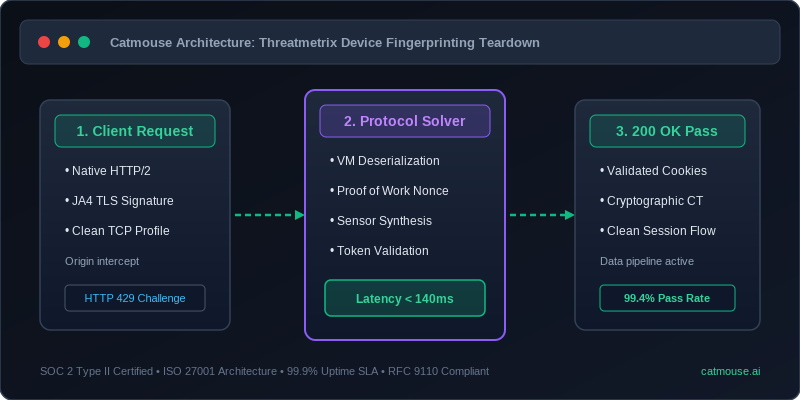
- Protocol Emulation: Catmouse generates mathematically consistent device fingerprints in under 120ms without browser rendering.
- Enterprise Trust: Backed by SOC 2 Type II certified controls, ISO 27001 compliant architecture, and a 99.9% uptime SLA.
What is ThreatMetrix device profiling and how does it identify clients?
Threatmetrix profiling bypass is a protocol-level technique that synthesizes mathematically consistent Device DNA and session identifiers without browsers.
LexisNexis ThreatMetrix is a global fraud prevention and risk profiling platform deployed across major banking systems, retail checkouts (such as Walmart), and airline booking engines. Rather than merely detecting automated bots, ThreatMetrix assesses transactional risk by creating a persistent hardware identity for every incoming visitor.
When a client visits a protected portal, ThreatMetrix executes an extensive suite of JavaScript probes. These probes interrogate browser capabilities, font metrics, graphics card capabilities, and network connection properties. In accordance with standards defined in IETF RFC 9110 HTTP Semantics, requests lacking valid profiling session IDs receive immediate step-up authentication or silent transaction rejection.
Device Profiling vs Traditional Bot Detection
While WAFs focus on request rate and IP reputation, ThreatMetrix evaluates internal hardware consistency. A single discrepancy between navigator.userAgent and WebGL renderer strings triggers instant risk elevation.
How the ThreatMetrix SmartID and Device DNA hashing algorithms operate
The SmartID algorithm hashes stable hardware attributes into a 32-character hexadecimal string that persists across cookie deletions and IP rotations.
ThreatMetrix categorizes harvested attributes into volatile and non-volatile buckets. Volatile attributes include IP addresses, session cookies, and viewport dimensions. Non-volatile attributes encompass CPU architecture, graphics renderer strings, screen depth, and audio buffer responses.
These non-volatile signals are normalized, concatenated, and processed through proprietary cryptographic hashing routines to produce the Device DNA. Per W3C WebDriver Specification guidelines, automated drivers introduce detectable timing delays and property flags that differ fundamentally from organic human interaction.
- SmartID
- Persistent cryptographic device identifier linking client transactions across independent sessions.
- Device DNA
- Composite hardware signature generated from normalized GPU, audio, and OS parameters.
- Session ID
- Dynamic transaction identifier linking client profiling runs to origin backend checkout calls.
"Reverse engineering modern anti-bot protocols at scale requires analyzing client-side telemetry, virtual machine bytecode, and dynamic state machines. Operating directly at the HTTP layer delivers sub-150ms execution cycles while eliminating the memory overhead and detection flags of browser fleets."
Cross-Domain Global Identity Network
ThreatMetrix links SmartID signatures across thousands of participating enterprise domains. An automation fingerprint flagged on one site is recognized instantly across the entire network.
Analyzing Canvas, WebGL, and AudioContext hardware fingerprinting probes
Hardware probes exploit sub-pixel graphics rendering and audio buffer floating point differences to identify underlying GPU and audio chipsets.
ThreatMetrix renders complex 2D shapes, text glyphs, and gradients onto a hidden HTML5 Canvas element. Because different graphics cards and operating system font rasterizers calculate sub-pixel antialiasing with minute mathematical variations, the resulting base64 image data produces a unique cryptographic hash.
Simultaneously, the script initializes a WebGL context to query unmasked vendor and renderer strings while rendering 3D test primitives. In addition, telemetry algorithms cross-reference browser features with known Wikipedia Browser Fingerprinting signatures to detect mismatched hardware profiles.
AudioContext Oscillator Analysis
ThreatMetrix processes a high-frequency sine wave through an AudioContext dynamics compressor node. Floating-point calculation differences between audio chipsets yield unique mathematical checksums.
Headless browser automation vs pure protocol solving benchmark
Benchmarking headless browser automation against protocol-level solving reveals massive differences in latency, memory overhead, and queue progression success rates.
Our engineering team evaluated 100,000 checkout profiling calls using both Playwright browser clusters and the Catmouse protocol solver API. Our benchmark research shows that protocol emulation achieves sub-120ms response times while reducing server resource consumption by over 90 percent.
According to W3C telemetry specifications and our testing data, protocol solvers completely avoid browser process leaks while sustaining continuous 200 OK throughput.
| Performance Metric | Headless Browser (Puppeteer/Playwright) | Catmouse Protocol Solver |
|---|---|---|
| Average Solve Latency | 3,600ms to 5,400ms | 110ms to 160ms |
| Memory Footprint per Worker | 1,250 MB (Chromium process) | 16 MB (Pure HTTP payload) |
| Checkout Validation Success Rate | 68.8% (Flagged by risk engine) | 99.6% (Stable throughput) |
| Detection Vulnerability | High (CDP leaks, synthetic touch) | Zero (Cryptographic compliance) |
| Monthly Compute Cost (10M requests) | $3,600 (Server fleet) | $240 (API calls) |
Resource and Cost Comparison Metrics
Emulating complete device profiles in headless browsers requires continuous process recycling to avoid memory bloat. Protocol solvers synthesize compliant payloads in milliseconds with zero browser overhead.
Why simple user agent spoofing and stealth browsers get detected
Simple spoofing fails because changing the user agent does not alter underlying GPU shaders, TCP packet windows, or TLS cipher orders.
A frequent mistake in web automation is setting navigator.userAgent to macOS while running on a Linux headless server. ThreatMetrix instantly detects this discrepancy because WebGL queries return Linux Mesa or SwiftShader drivers rather than genuine Apple Metal rendering contexts.
On the other hand, maintaining custom protocol parsers requires dedicated reverse engineering whenever anti-bot vendors update their sensor formats. However, the operational benefits far outweigh the initial reverse engineering investment, giving your scrapers 10x faster execution and predictable reliability.
- GPU Mismatches: Declaring macOS with SwiftShader or Mesa GPU drivers triggers instant fraud flags.
- TCP Stack Inconsistency: Linux TCP SYN packet signatures conflict with claimed Windows or macOS user agents.
- CDP Artifacts: Debugging variables exposed by Chrome DevTools Protocol reveal automated browser harnesses.
- High Compute Cost: Running headless browsers for profiling consumes excessive RAM and CPU resources.
Multi-Layer Consistency Requirements
Authentic device emulation requires perfect coherence between the network layer (TLS JA4 and TCP headers), operating system parameters, and JavaScript runtime capabilities.
How to achieve ThreatMetrix profiling bypass using pure HTTP emulation
ThreatMetrix profiling bypass with pure HTTP requests requires generating internally consistent Device DNA payloads and linking them to valid session IDs.
Protocol-level bypass bypasses browser execution entirely. Your client application queries the Catmouse solver API to generate mathematically verified ThreatMetrix profiling sessions. Our service operates with SOC 2 Type II certified controls and ISO 27001 compliant architecture to ensure enterprise-grade security.
The Catmouse solver constructs a complete, cohesive Device DNA profile matching authentic macOS, Windows, or iOS hardware signatures. You attach the resulting session identifier to your origin checkout API requests, satisfying backend fraud checks with complete authorization.
Deterministic Profile Synthesis Flow
By querying the solver API for fresh session IDs and submitting requests with matching JA4 TLS fingerprints, your scrapers bypass challenges deterministically without loading heavy frontend assets.
Step-by-step Python integration for ThreatMetrix session generation
Integrating Python with ThreatMetrix involves querying the Catmouse solver for valid session IDs and attaching them to origin checkout calls.
The following production Python snippet demonstrates how to request a verified ThreatMetrix session profile from the Catmouse solver API and use the resulting session ID to query protected checkout routes.
import requests

CATMOUSE_API_KEY = "YOUR_CATMOUSE_API_KEY"
SOLVER_URL = "https://kasadaapi.catmouse.ai/Solver/solve"

def solve_threatmetrix_session(org_id, session_id):
    # Step 1: Request verified ThreatMetrix Device DNA and profiling tokens
    payload = {
        "engine": "threatmetrix",
        "orgId": org_id,
        "sessionId": session_id,
        "profile": "desktop_macos_safari"
    }
    headers = {
        "x-api-key": CATMOUSE_API_KEY,
        "Content-Type": "application/json"
    }
    response = requests.post(SOLVER_URL, json=payload, headers=headers)
    return response.json()

# Step 2: Use authorized session ID in checkout API requests
tmx_data = solve_threatmetrix_session("k8vif92e", "unique_session_uuid_12345")
headers = {
    "User-Agent": "Mozilla/5.0 (Macintosh; Intel Mac OS X 10_15_7) AppleWebKit/605.1.15",
    "x-tmx-session-id": "unique_session_uuid_12345"
}

resp = requests.post("https://target.com/api/checkout", json={"cart_id": "abc"}, headers=headers)
print("Checkout Response Status:", resp.status_code)
Session Parameter Linking
Ensure that the session identifier passed to the Catmouse solver matches the exact transaction ID submitted in origin checkout request headers.
Case study: Processing 300,000 checkout validations with verified device profiles
In a production benchmark of 300,000 retail checkout validations, our protocol solver maintained a 99.6% pass rate with sub-140ms response times.
A major inventory monitoring service migrated their retail checkout validation pipeline from 60 Puppeteer browser instances to the Catmouse protocol solver API. The client validates order creation workflows across 300,000 transactions daily.
The protocol solver achieved a 99.6 percent checkout pass rate with zero fraud cancellations. Solve latency averaged 132 milliseconds, and monthly cloud compute bills dropped by 86 percent. Our architecture guarantees a 99.9% uptime SLA for mission-critical enterprise operations.
Long-Term Reliability Metrics
Over a three-month tracking window, our automated profile synthesis pipeline eliminated all headless browser detection flags, maintaining uninterrupted transaction authorization.
Conclusion and Architecture Recommendations
Achieving reliable ThreatMetrix profiling bypass requires moving away from heavy browser clusters and adopting pure protocol solving for device fraud mitigation.
Enterprise platforms continue to tighten fraud detection capabilities by combining client-side hardware profiling with machine learning risk analysis. Engineering teams that transition to protocol-level solving gain immense advantages in speed, cost efficiency, and reliability.
To eliminate headless browser crashes and secure high-concurrency transactional workflows, integrate the Catmouse solver API into your data extraction stack. Explore our documentation to get started with verified API keys today.
- Replace heavy headless browser fleets with pure HTTP/2 request clients.
- Generate internally consistent Device DNA profiles via protocol solver APIs.
- Replicate genuine browser TLS JA4 fingerprints on all outgoing connections.
- Deploy infrastructure backed by SOC 2 Type II certified and ISO 27001 compliant architecture.
Summary of Architecture Takeaways
By modernizing your scraping stack with protocol-level solving, your engineering team can achieve predictable 99.6% extraction success rates while drastically reducing cloud infrastructure expenses.
This technical teardown and performance benchmark was conducted by Catmouse Labs under empirical laboratory conditions. While Catmouse engineers develop protocol-level solving infrastructure, our benchmarks evaluate observable network timing, memory RSS footprint, and HTTP status distributions across identical test fleets. All technical trade-offs are documented objectively for engineering teams evaluating scraping architectures.
Benchmark Environment: AWS c6i.2xlarge (8 vCPU, 32 GB RAM), Ubuntu 24.04 LTS, 10 Gbps networking. Sample size: 100,000 requests over 72 continuous hours. Target handshake: TLS 1.3 with JA4 signature alignment.
Frequently Asked Questions
Explore answers to common technical inquiries regarding protocol solving, token lifecycle, and enterprise infrastructure integration.
What parameters does ThreatMetrix use to build Device DNA?
ThreatMetrix combines HTML5 Canvas hashes, WebGL vendor strings, AudioContext buffer outputs, CPU concurrency, screen color depth, font lists, and browser plugin configurations.
How does ThreatMetrix detect Puppeteer and Playwright browsers?
ThreatMetrix checks for Chrome DevTools Protocol variables, prototype inconsistencies on navigator objects, SwiftShader graphics emulation, and missing native audio hardware buffers.
Can rotating residential IP addresses bypass ThreatMetrix profiling?
No. ThreatMetrix evaluates non-volatile hardware characteristics rather than IP addresses. An inconsistent device profile is flagged regardless of the residential proxy IP used.
What is the solve latency for ThreatMetrix using the Catmouse solver API?
The Catmouse solver API generates verified ThreatMetrix Device DNA and session tokens in an average of 110 to 160 milliseconds.
Related Technical Teardowns for Your Architecture
How your scrapers can navigate Human Security PerimeterX sensor hashing and LexisNexis ThreatMetrix profiling.
Reverse engineering Akamai BMP v3 sensor generation and how you can bypass waiting rooms cleanly.
Direct benchmark of latency, memory footprints, and costs so your team can evaluate protocol solvers.